The Art of Living Well in Less Space: European Design Principles for the American Home
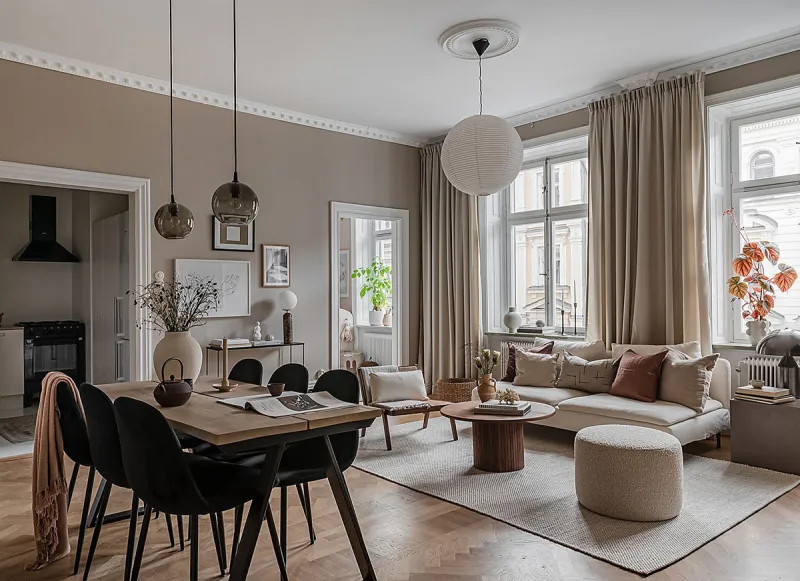
Photo: minimalist European apartment interior small space elegant Scandinavian design, via decoholic.org
Why European Apartments Punch Above Their Weight
Walk into a well-appointed apartment in Stockholm, Amsterdam, or Milan and something will strike you immediately: the space feels complete. Not cramped, not provisional, not decorated around the idea that something better is coming once there is more room. These interiors—often no larger than a generous American studio—feel resolved. Intentional. Quietly confident.
This quality does not emerge by accident. It is the product of a design philosophy shaped by necessity and refined over generations. European urban density has long forced a reckoning with the question of how to live beautifully within limits. The answers that have emerged from that reckoning translate remarkably well to American contexts, particularly as more households find themselves navigating apartments, townhouses, and smaller suburban footprints.
The principles are worth examining closely.
Quality as the Foundation, Not the Finishing Touch
The most significant departure between the European approach to furnishing and the American default is the relationship to quality. In the United States, the prevailing tendency—encouraged by the economics of fast furniture and the cultural appetite for novelty—is to fill a space quickly and upgrade later. The result is rooms populated by pieces that are neither well-made nor particularly loved, replaced on a cycle that generates both expense and waste.
The European model inverts this logic. The preference is to acquire fewer pieces, chosen with genuine care, that will remain relevant and functional for decades. A solid oak dining table purchased at some sacrifice in one's twenties is still a beautiful dining table at fifty. A sofa upholstered in durable, high-quality fabric does not need replacing every five years.
This is not merely an aesthetic position—it is a financial one. The cost-per-year calculation on a well-made piece almost always outperforms its cheaper counterpart. And in a small space, where every object is visible and nothing can be hidden in an excess of square footage, the quality of each piece matters enormously.
The Multifunctional Imperative
In a Parisian apartment of six hundred square feet, a dining table that seats eight for dinner parties but collapses to a console against the wall during the week is not a clever trick—it is a necessity. European designers and manufacturers have responded to this reality with decades of innovation in multifunctional furniture, much of which is now available to American consumers through specialty retailers and import shops.
A few categories worth exploring:
Convertible sofas and daybeds in the European tradition bear little resemblance to the utilitarian sleeper sofas familiar to most Americans. Scandinavian and Italian manufacturers in particular have developed pieces that function as sophisticated seating during the day and genuinely comfortable sleeping surfaces at night, without visual compromise.
Storage ottomans and benches serve triple duty as seating, surface, and concealed storage—particularly useful in entryways and living rooms where clutter otherwise accumulates.
Extendable dining tables are ubiquitous in European homes and remain underutilized in American ones. A table that seats four in its everyday configuration and eight when extended accommodates real life without demanding permanent square footage for the larger footprint.
Built-in and wall-mounted shelving deserves special mention. Where American homes often treat bookshelves as freestanding afterthoughts, European interiors tend to incorporate shelving into the architecture of the room—floor-to-ceiling, flanking windows, wrapping corners. This approach maximizes vertical space, draws the eye upward (making rooms feel taller), and provides substantial storage without consuming floor area.
The Visual Logic of Small Spaces
Beyond furniture selection, the European small-space aesthetic is governed by a set of visual principles that create the impression of volume and calm even within tight dimensions.
Restraint in color is perhaps the most immediately applicable. Pale, tonal palettes—the whites, warm grays, and soft naturals that dominate Scandinavian and Dutch interiors—reflect light and minimize visual fragmentation. This does not mean sterility; texture, layered through linen, wool, and natural wood, provides warmth without visual noise.
Editing as a practice is equally important. European apartments tend to contain fewer decorative objects, each chosen deliberately. An American impulse toward surfaces crowded with mementos, collections, and decorative accumulation works against the sense of spaciousness. The discipline of removing things—of asking whether each object earns its place—is a learned skill, but a rewarding one.
Mirrors and light are deployed strategically. A large mirror on a wall opposite a window doubles perceived depth and amplifies natural light. European designers treat mirrors as architectural tools rather than purely decorative ones.
Sustainability as a Natural Consequence
There is an environmental dimension to this philosophy that deserves acknowledgment. The buy-less-buy-better ethos that characterizes the European approach to furnishing is, almost incidentally, a more sustainable one. Fewer pieces produced, longer lifespans, less waste—the ecological math is straightforward.
For American consumers increasingly attentive to the environmental cost of their purchasing decisions, the European small-space model offers a coherent framework that aligns aesthetic aspiration with responsible consumption. A beautifully furnished small apartment is not a compromise; it is a considered choice.
Beginning the Edit
For those ready to apply these principles to their own homes, the starting point is not acquisition but assessment. Walk through your space and identify what is earning its keep—what is functional, what is beautiful, what is both. Everything else is a candidate for removal.
From that cleared foundation, the European approach suggests investing first in the pieces that anchor daily life: a quality sofa, a proper dining surface, a bed with a frame and headboard that feel permanent rather than provisional. Build outward from these anchors with intention, resisting the impulse to fill every surface and corner.
At Lemes & Co., we believe that a well-furnished home is not a function of space—it is a function of care. The Europeans have understood this for a long time. It is a lesson worth importing.