Woven to Last: The European Philosophy of Treating Bed Linens as a Lifelong Investment
There is a particular kind of satisfaction that comes from sleeping beneath sheets that have been laundered a hundred times. They soften without fraying. They breathe without thinning. They carry, in some ineffable way, the quiet authority of something made to endure. This is not an accident—it is the direct result of a purchasing philosophy that much of Europe has practiced for generations and that American households are only now beginning to discover.
For many European families, bed linens are not a seasonal purchase or a casual replacement. They are an investment, chosen with deliberation, cared for with intention, and occasionally passed from one generation to the next. The idea that a set of sheets might outlast a decade—let alone a lifetime—strikes many American shoppers as almost quaint. But as the fast-home-goods model begins to show its limitations, that quaintness is starting to look a great deal like wisdom.
The Problem with Disposable Bedding
Walk through any large American home goods retailer and you will find sheets priced for accessibility and designed, whether intentionally or not, for replacement. The fabrics are often a blend of synthetic fibers and lower-grade cotton, woven loosely enough to feel plush at the point of sale but prone to pilling, fading, and deterioration within a year or two of regular use. The result is a cycle of purchase and discard that costs more over time than it saves in the short term—and that produces a bedroom experience defined by mediocrity.
The European model inverts this entirely. The upfront expenditure is higher, sometimes significantly so, but the calculus changes when you consider longevity. A set of high-quality linen or long-staple cotton sheets purchased today may still be performing beautifully in fifteen years. Amortized across that span, the cost per night of sleep becomes remarkably modest—and the experience, considerably richer.
Understanding What You Are Actually Buying
The language of bedding is rife with marketing terminology that can obscure more than it reveals. Thread count, for instance, has long been used as a shorthand for quality, but it is a deeply imperfect metric. A sheet woven from shorter cotton fibers can achieve a high thread count by twisting multiple strands together, resulting in a fabric that feels heavy and dense but lacks the durability and breathability of a simpler weave made from superior raw material.
What matters far more than thread count is fiber length and origin. Long-staple cotton varieties—Egyptian cotton grown in the Nile Delta, Supima cotton cultivated in the American Southwest, and Pima cotton from Peru—produce fibers that are longer, stronger, and smoother than standard cotton. Sheets made from these materials have a natural luster, a silky hand feel, and a remarkable resistance to pilling. They improve, rather than deteriorate, with repeated washing.
Linen, the fabric woven from the flax plant and produced primarily in Belgium, France, and Ireland, operates on a different timeline altogether. It begins life slightly coarse and only grows softer with use. A linen sheet set purchased today will reach its peak softness somewhere around its fifth or sixth year of regular laundering—a fact that requires a certain patience but promises a reward that synthetic alternatives cannot approximate.
The Geography of Quality
European textile traditions are deeply regional, and understanding those origins can help American shoppers make more informed decisions. Belgian linen, produced in the Flanders region, is widely regarded as among the finest in the world, owing to the quality of the local water used in the retting process—the method by which flax fibers are separated from the plant. Portuguese percale, woven in the country's storied textile mills, offers a crisp, cool finish particularly suited to warmer climates. Italian sateen from the mills of Emilia-Romagna carries a subtle sheen and a drape that feels genuinely luxurious.
When shopping for investment-grade linens, look for products that name their fabric source specifically. Vague descriptions like "European linen" or "premium cotton" warrant scrutiny. Transparent brands will tell you precisely where their fiber was grown, where it was woven, and what certifications the mill holds—OEKO-TEX Standard 100 being one of the most reliable indicators of both quality and responsible production.
Building a Considered Linen Closet
The European approach to stocking a linen closet is not about abundance—it is about sufficiency and quality. Rather than accumulating a dozen sets of mediocre sheets, the goal is to own three or four sets of genuinely excellent ones and to rotate them with care.
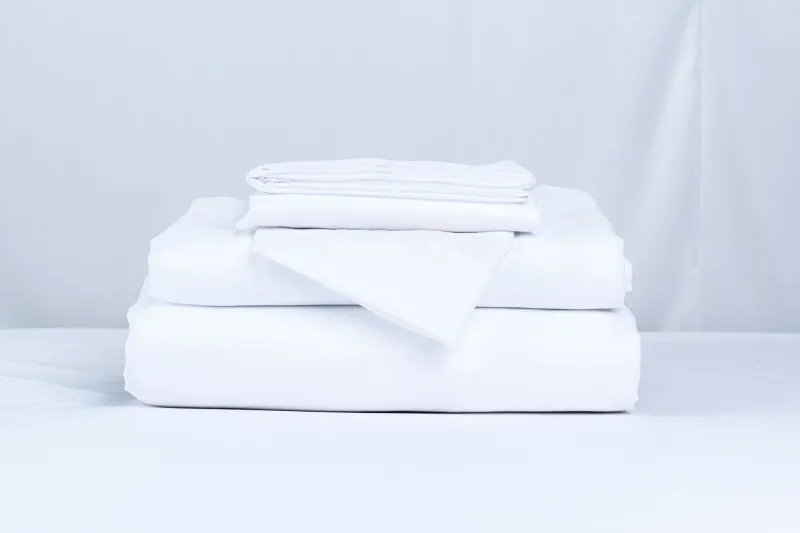
A practical starting point for the American household making this transition might look something like this: two sets of linen or long-staple cotton sheets in a neutral tone—white, warm ivory, or a soft stone—that will coordinate effortlessly with any duvet or coverlet. These become your foundation. A third set in a slightly warmer or more textured weave can serve the cooler months, offering variety without requiring an entirely separate collection.
Storage matters as well. Europeans have long favored linen closets with adequate ventilation, where sheets are folded loosely and allowed to breathe rather than compressed into tight plastic packaging. Scenting the closet with dried lavender sachets or cedar is a small ritual that connects the practical act of storage to something more sensory and pleasurable—a reminder that caring for beautiful things is itself a form of living well.
The Emotional Dimension of Lasting Textiles
There is something worth acknowledging beyond the purely practical. The act of investing in bed linens that are meant to last carries an emotional weight that disposable goods simply cannot replicate. It is a declaration, however quiet, that your daily life deserves materials of substance—that the eight hours you spend in bed each night are worth attending to with the same care you might bring to a well-set dinner table or a thoughtfully chosen coat.
Several American consumers who have made this shift describe a subtle but meaningful change in how they relate to their homes. When a set of sheets has accompanied you through a decade of mornings, it accumulates a kind of presence. It becomes, in the best sense, familiar.
The European linen closet is not a luxury reserved for those with expansive budgets or ancestral estates. It is, at its core, an argument for paying attention—for choosing fewer things, better made, and allowing them to become part of the texture of a life well lived. That is a philosophy entirely within reach, and one that pays dividends long after the initial investment has been forgotten.