The Passage With Purpose: Giving Your Home's Forgotten Corridors a European Soul
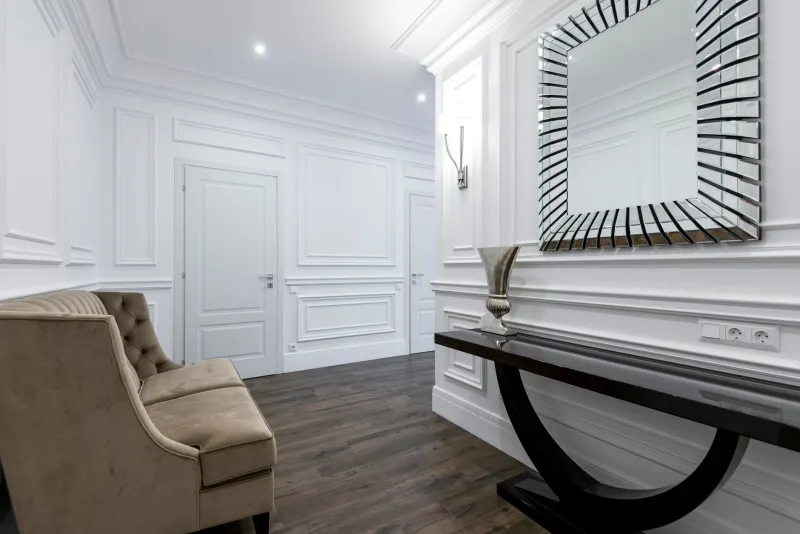
There is a particular kind of space that most American homes possess in abundance and design in scarcity: the transitional zone. The narrow hallway between the front door and the living room. The awkward alcove at the base of the stairs. The mudroom that serves as a staging area for umbrellas, keys, and the residue of daily life. These spaces are treated, almost universally, as necessary inconveniences—functional by obligation, beautiful by accident.
In much of Europe, this attitude would be considered a quiet form of negligence. The French have long understood that how a home receives you matters as much as what lies beyond the threshold. The Italians give even the smallest vestibule its own identity. The Danes and Swedes, working within the constraints of compact urban apartments, have elevated the entryway to something approaching an art form. The principle underlying all of these traditions is the same: no space in a well-considered home is allowed to be thoughtless.
For the American homeowner willing to look at these forgotten corners with fresh eyes, the rewards are considerable. A passage that has been designed with intention does not merely look better—it changes how you feel every time you move through it.
The Architecture of Arrival
Before selecting a single object, it is worth pausing to consider what a transitional space is actually meant to accomplish. Unlike a living room or dining room, which are defined by the activities they host, a corridor or entryway exists in a state of perpetual motion. People move through it rather than inhabiting it. Its purpose, then, is not to hold attention but to shape it—to prepare the visitor, or the returning resident, for what comes next.
European designers approach this challenge by thinking in terms of sequence. The entryway is not merely the first room; it is the first sentence of the home's larger narrative. It sets tone, establishes register, and offers a preview of the aesthetic sensibility that governs the rest of the interior. A single well-chosen console table, positioned against a bare wall, can accomplish more in this regard than a room full of furniture arranged without conviction.
Begin by identifying what the space already possesses. Good natural light, even in small quantities, is an asset worth amplifying. An unusual architectural detail—a niche, a low ceiling, an unexpected angle—can become a focal point rather than an obstacle. The European instinct is never to fight the room's existing character but to work with it, allowing its quirks to become distinguishing features.
The Console Table as Cornerstone
If there is a single piece of furniture that defines the European approach to transitional spaces, it is the console table. Slender, purposeful, and inherently elegant, it occupies the minimum footprint while delivering the maximum visual impact. Against a hallway wall or just inside a front door, a console table signals immediately that the space has been considered.
The choice of material and finish matters enormously. A table in aged oak or walnut speaks to permanence and warmth. One in painted iron or brass-tipped wood introduces a more formal, Continental sensibility. What the table holds is equally important: a small ceramic vessel containing a single stem or a modest arrangement of dried botanicals; a shallow tray for keys and correspondence; perhaps a low lamp whose light pools softly downward rather than flooding the corridor with overhead brightness.
The lamp, in particular, deserves special attention. One of the most common mistakes in American home design is the reliance on harsh overhead lighting in transitional spaces. European interiors favor layered, low-level light—sconces positioned at eye height, table lamps that create intimacy rather than illumination, the occasional candle lantern for evening hours. In a hallway or entryway, a single lamp on a console table can transform the quality of the entire space, making it feel considered and calm rather than utilitarian.
A Single Work on the Wall
The temptation, when faced with a bare hallway wall, is to fill it. A gallery arrangement, a series of framed photographs, a collection of mirrors—these are the instinctive American solutions. The European response is typically more restrained: one work, chosen carefully, hung at precisely the right height.
This is not minimalism for its own sake. It is an acknowledgment that a transitional space, by definition, does not hold the viewer's gaze for long. A single strong image—a landscape print, an abstract in muted tones, a botanical study framed in dark wood—registers in passing and leaves an impression. A wall crowded with competing images asks for attention that a corridor cannot reasonably provide.
The selection of that single work is an act of genuine editorial judgment. It should reflect something essential about the home's character without attempting to summarize it entirely. Think of it as a title page rather than a table of contents.
The Small Ceramic Vessel and the Logic of Restraint
No element of European decorative tradition is more instructive than its relationship with the vessel. From Scandinavian stoneware to Italian majolica to the understated pottery of the French countryside, the ceramic object occupies a place of genuine cultural significance. It is not merely decorative; it is a marker of taste, of patience, of the understanding that a single beautiful thing is worth more than a dozen adequate ones.
In a transitional space, a small ceramic vessel—placed on the console table, set into a wall niche, or positioned on a low shelf—performs a function that goes beyond the visual. It introduces texture, weight, and a handmade quality that softens the hard geometry of walls and floors. It suggests that someone chose this object deliberately, carried it home, and found exactly the right place for it.
This is the logic of restraint in practice: not the absence of things, but the presence of the right ones.
Making the Passage Feel Deliberate
The cumulative effect of these choices—the console table, the layered lighting, the single artwork, the ceramic vessel—is something that is genuinely difficult to achieve through any other means: a sense of arrival. Not the dramatic arrival of a grand foyer, but the quiet, satisfying arrival of a space that knows what it is and why it exists.
For the thirty seconds it takes to move from the front door to the living room, or from the mudroom to the kitchen, this intentionality matters. It tells everyone who passes through—guests and residents alike—that the home they are entering has been thought about from its very first square foot.
That is, in the end, the European lesson that translates most directly to the American context: not that you need more space, or more money, or more objects, but that the spaces you already have deserve to be taken seriously. Even the ones you pass through without stopping. Perhaps especially those.