The Ritual of the Unopened Envelope: How Europeans Turn Daily Mail Into a Moment of Intention
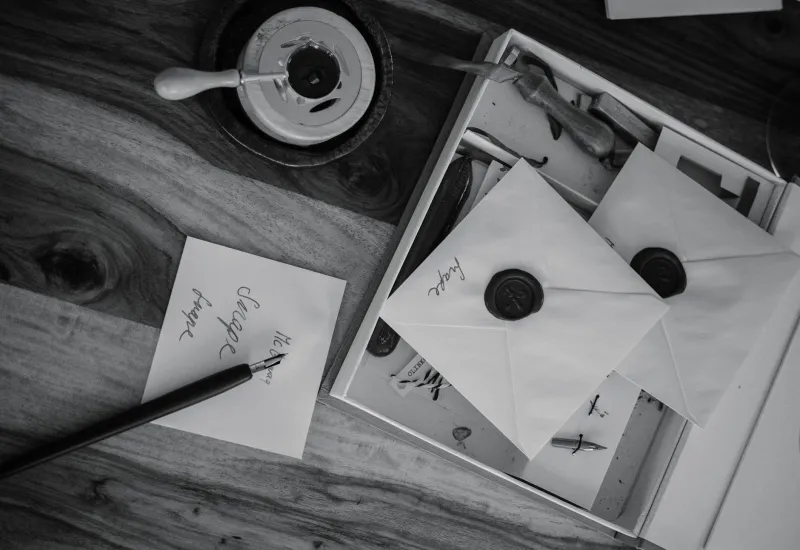
There is a moment, brief and easily squandered, that occurs each day somewhere between the front door and the kitchen counter. You retrieve the mail, shuffle through it with half a mind on dinner, and tear open whatever seems remotely important before discarding the rest. It is an entirely unremarkable transaction—or so the modern American household has come to accept.
In many parts of Europe, however, this same moment is treated with a kind of quiet ceremony. A dedicated place at the desk. A pause before the pile is addressed. And, almost invariably, a letter opener—held properly, used deliberately, returned to its place when the task is complete.
This is not nostalgia for its own sake. It is something more instructive: the recognition that even the most ordinary daily act, when approached with intention, can become an anchor of calm in an otherwise relentless day.
The Object That Changes Everything
The letter opener is, by any functional measure, a simple instrument. A blade, a handle, a purpose so narrow it borders on the redundant in an era when most correspondence arrives as a push notification. And yet, the Europeans who keep one on their desks—and there are many—will tell you that the object itself is almost beside the point. What matters is what the object represents: a commitment to doing one small thing with full attention.
A well-crafted letter opener, whether fashioned from sterling silver, horn, polished wood, or lacquered brass, carries a particular gravity. It asks you to sit down. It asks you to hold it properly. It asks, in its quiet way, that you be present for what you are about to read. This is not an accident of design. It is the entire philosophy made physical.
In many European households, the letter opener is an inherited object—passed from a grandparent's writing desk to a parent's study and eventually to one's own. It arrives not merely as a tool but as a kind of testimony: proof that someone, once, believed that the act of reading correspondence was worth honoring.
Slowing Down Is Not Inefficiency
American culture has long equated speed with productivity, and nowhere is this more apparent than in our relationship with daily tasks. We open mail while standing. We skim rather than read. We treat the physical envelope as an obstacle between ourselves and the information it contains, rather than as the beginning of a more considered exchange.
The European approach inverts this entirely. The envelope is not an obstacle. It is the first gesture of a conversation—one that deserves to be received with some degree of grace.
Psychologists who study attention and mindfulness have noted for years that small, ritualized behaviors serve as powerful cues for the brain. When you repeat the same sequence of deliberate actions—sitting at a designated space, selecting the appropriate tool, opening correspondence with care—you signal to yourself that this moment is distinct from the noise that surrounds it. The result is not merely aesthetic. It is neurological. You arrive more fully at what you are doing.
In a culture saturated with digital communication, the physical letter or document that arrives by post has become, paradoxically, more significant. It is the thing someone took the trouble to send. It deserves, at minimum, the trouble of being opened properly.
The Desk as Staging Ground
One cannot discuss the European mail ritual without acknowledging its natural habitat: the dedicated writing surface. The desk, in the continental tradition, is not simply a place where work happens. It is a considered environment—curated, maintained, and treated as a reflection of the person who occupies it.
A letter opener does not live in a drawer. It sits in a holder, or beside the inkwell, or at the edge of the blotter, positioned so that it is immediately accessible and visually present. This visibility is intentional. The object on the desk is a daily reminder of the standard one has set for oneself.
For American readers looking to adopt something of this sensibility, the investment need not be dramatic. A small tray for incoming correspondence. A single quality implement for opening it. A few minutes set aside each day—not while multitasking, not while watching television—but at the desk, with the mail given its due. These are modest adjustments, but their cumulative effect on one's sense of order and presence is genuinely significant.
Choosing an Instrument Worth Keeping
If you are persuaded that the letter opener deserves a place in your daily life, the question becomes one of selection. And here, the European philosophy of acquisition applies with particular force: buy once, buy well, and buy something you would not mind passing on.
A letter opener in solid brass or sterling silver will outlast its owner with appropriate care. One fashioned from a single piece of hand-turned hardwood—walnut, cherry, or olive—develops a patina over decades of use that no newly purchased object can replicate. These are not extravagances. They are the opposite: investments in objects that will never require replacement, never contribute to waste, and never fail to perform their single, elegant function.
The handle matters as much as the blade. It should sit comfortably in the hand, with enough weight to feel purposeful without becoming unwieldy. The blade itself should be smooth-edged—sharp enough to open an envelope cleanly but never dangerously so. The experience of drawing it along the paper fold should be satisfying in the way that only a well-made tool can be.
The Correspondence That Arrives Anyway
It would be disingenuous to pretend that the majority of American mail warrants reverence. Credit card offers, pharmacy circulars, and real estate postcards are not, by any reasonable measure, correspondence worth savoring. And yet, even here, the ritual has something to offer.
The act of opening everything deliberately—the mundane alongside the meaningful—trains the attention in a way that selective engagement cannot. You are not performing a ceremony for the benefit of the envelope. You are performing it for the benefit of yourself: reinforcing the habit of presence so that when something genuinely important arrives, you are already in the posture to receive it.
Europeans understand this intuitively. The ritual is not about the mail. It is about the person opening it—about choosing, each day, to meet even the ordinary with a measure of care.
A Small Act With Lasting Resonance
There is something quietly radical about reclaiming the mundane. In a world designed to accelerate every transaction and eliminate every pause, the decision to open a letter with a proper instrument, at a proper desk, in a proper moment of attention, is a small but genuine act of resistance.
It costs very little. It requires almost no time. And it returns, in ways both practical and psychological, far more than it demands.
At Lemes & Co., we have long believed that the European approach to everyday objects—selecting fewer, choosing better, using with intention—has much to teach the American household. The letter opener is perhaps the most modest illustration of this philosophy. But it is also, in its quiet way, one of the most persuasive.
Begin there. The rest of the desk, and the ritual that surrounds it, will follow naturally.